The JEE Main Cutoff 2026 refers to the minimum percentile scores required for candidates to qualify for JEE Advanced 2026 (for IIT admissions) and to participate in counseling processes such as JoSAA for NITs, IIITs, GFTIs, and other institutes. As of March 2026, only the session 1 (January session) of JEE Main 2026 has been conducted. The JEE Main cutoff will be announced after the session 2 exams are successfully completed from April 2-9 2026. It is crucial to note that JEE Main cutoff is released in percentile, not marks. Marks vary each year depending on exam difficulty, while the percentile cutoff determines eligibility for JEE Advanced.
While the JEE Main cutoff 2026 is not officially released, here are the expected results for various categories:
| Category | Expected Qualifying Percentile (2026) | Notes / Common Range from Sources |
General (UR) | 93 – 95 | Stable/slight increase from 2025 (~93.10) due to competition |
| EWS | 80 – 82.5 | Commonly 80–82 or 80.5–82.5; proportional relaxation |
| OBC-NCL | 79 – 82 | Frequently 79–81 or 79.5–81.5; similar to EWS trends |
| SC | 60 – 63 | Around 60–62 or 61–63; consistent with past years |
| ST | 47.5 – 50 | Often 47–50 or 48–50; lowest among main categories |
| UR-PwD | 0.001 – 1 | Very low (typically <0.02 or up to 1); historical pattern for PwD |
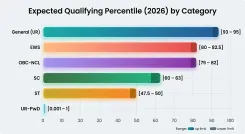
Table of Contents
JEE Mains Cutoff 2025
The JEE Mains 2025 Cutoff represents the minimum percentiles required for each category to qualify among top 2.5 lakh candidates. NTA caps the candidates who can appear for JEE Advanced at roughly 2.5 lakhs - this rule is discussed ahead in detail.
The cutoff of JEE Mains 2025 is based on NTA data.
| Category | Qualifying Cutoff Percentile (2025) |
| General (UR) | 93.1023262 |
| EWS | 80.3830119 |
| OBC-NCL | 79.4313582 |
| SC | 61.1526933 |
| ST | 47.9026465 |
| UR-PwD | 0.0079349 |
JEE Main Cutoff 2024
The JEE Mains 2024 cutoff determines eligibility for JEE Advanced 2024 and ranking among the top ~2.5 lakh candidates. The cutoff of jee mains 2024 was announced after Session 2 results in April 2024. For the obc cutoff for jee mains 2024, it stood at 79.6757881 percentile. To check all other categories as well, take a look at the table below:
| Category | Qualifying Cutoff Percentile (2024) |
| General (UR) | 93.2362181 |
| EWS | 81.3266412 |
| OBC-NCL | 79.6757881 |
| SC | 60.0923182 |
| ST | 46.6975840 |
| UR-PwD | 0.0018700 |
JEE Mai Cutoff 2023
The JEE Main 2023 cutoff was announced after the final Session 2 results in April 2023, based on normalized scores from multiple shifts and high participation levels. Compared to previous years, the jee mains 2023 cutoff showed a notable increase across categories, reflecting stronger overall performances and competition.
Here is the official category-wise qualifying cutoff table for JEE Main 2023:
| Category | Qualifying Cutoff Percentile (2023) |
| General (UR) | 90.7788642 |
| EWS | 75.6229025 |
| OBC-NCL | 73.6114227 |
| SC | 51.9776027 |
| ST | 37.2348772 |
| UR-PwD | 0.0013527 |
JEE Main Cutoff 2022
The JEE Main 2022 cutoff established the minimum requirements for eligibility to JEE Advanced 2022 and ranking in the top ~2.5 lakh candidates. These were announced after the Session 2 results in August 2022, based on normalized scores from multiple shifts and high candidate participation.
Compared to 2021, the jee mains 2022 cutoff showed a slight increase for the General category and variations in reserved categories, influenced by exam patterns and overall performance.
Here is the official category-wise qualifying cutoff table for JEE Main 2022:
| Category | Qualifying Cutoff Percentile (2022) |
| General (UR) | 88.4121383 |
| EWS | 63.1114141 |
| OBC-NCL | 67.0090297 |
| SC | 43.0820954 |
| ST | 26.7771328 |
| UR-PwD | 0.0031029 |
JEE Main Cutoff 2021
The JEE Main 2021 cutoff was announced after the final Session 4 results in September 2021 (with multiple sessions held due to the pandemic schedule), based on normalized NTA scores from various shifts and high participation.
Here is the official category-wise qualifying cutoff table for JEE Main 2021:
| Category | Qualifying Cutoff Percentile (2021) |
| General (UR) | 87.8992241 |
| EWS | 66.2214845 |
| OBC-NCL | 68.0234447 |
| SC | 46.8825338 |
| ST | 34.6728999 |
| UR-PwD | 0.0096375 |
JEE Main Cutoff 2020
The JEE Main 2020 cutoff was announced after the final September session results in September 2020 (following January and September attempts due to the pandemic). Take a look at the category-wise cutoff for the year here:
| Category | Qualifying Cutoff Percentile (2020) |
| General (UR) | 90.3765335 |
| EWS | 70.2435518 |
| OBC-NCL | 72.8887969 |
| SC | 50.1760245 |
| ST | 39.0696101 |
| UR-PwD | 0.0618524 |
JEE Main Qualifying Cutoff vs Admission Cutoff
Understanding qualifying cutoff vs admission cutoff is a crucial criterion. Take a detailed look at them below:
JEE Main Qualifying Cutoff: It is the minimum percentile required to become eligible for JEE Advanced. It is released by NTA along with the JEE Main results and varies every year depending on factors like exam difficulty, number of candidates, and overall performance.
If you don’t directly want to take admission after JEE Main and attempt JEE Advanced, this is what you should check.
JEE Main Admission Cutoff: It refers to the rank range required to get admission into institutes like NITs, IIITs, and GFTIs through JoSAA counselling. It varies for every college, branch, category, and quota, and is determined during the counselling seat allocation process.
If you wish to go straight for admissions after JEE Main, focus on the JEE Main admission cutoff.
JEE Main Marks vs Percentile
Have you also been confused between JEE Main marks vs JEE Main percentile? Don’t worry, this is a prevalent confusion among most students. Here is an easy overview for clearer understanding:
JEE Main Marks:Marks are the actual score you obtain in the exam out of 300. JEE Main follows a marking scheme where correct answers add marks and incorrect ones may lead to negative marking.
JEE Main Percentile: Percentile indicates your relative performance compared to other candidates. For example, a 90 percentile means you scored better than 90% of the candidates who appeared for the exam.
JEE Main results and cutoffs are announced in percentile, not marks. The NTA shows both - your marks and percentile. So, you can easily compare your percentile with the cutoff percentile to assess your result.
JEE Main 2026 Expected Marks vs Rank vs Percentile Table
| Marks Range (Approx.) | Likely Percentile | Estimated Rank Range |
| 250 – 300 | 99.9+ | 1 – 1,000 |
| 220 – 250 | 99.5 – 99.9 | 1,000 – 5,000 |
| 190 – 220 | 99.0 – 99.5 | 5,000 – 12,000 |
| 170 – 190 | 98.0 – 99.0 | 12,000 – 25,000 |
| 150 – 170 | 97.0 – 98.0 | 25,000 – 40,000 |
| 130 – 150 | 95.0 – 97.0 | 40,000 – 65,000 |
| 110 – 130 | 92.0 – 95.0 | 65,000 – 1,00,000 |
| 90 – 110 | 85.0 – 92.0 | 1,00,000 – 1,80,000 |
| 70 – 90 | 75.0 – 85.0 | 1,80,000 – 2,80,000 |
JEE Main 2025 Marks vs Percentile Table
| Marks Range (Out of 300) | Approximate Percentile Range (2025) |
| 280 – 300 | 99.99+ – 100 |
| 250 – 279 | 99.95 – 99.99 |
| 220 – 249 | 99.80 – 99.95 |
| 200 – 219 | 99.50 – 99.80 |
| 180 – 199 | 99.00 – 99.50 |
| 160 – 179 | 98.00 – 99.00 |
| 140 – 159 | 97.00 – 98.00 |
| 120 – 139 | 95.00 – 97.00 |
| 100 – 119 | 90.00 – 95.00 |
| Below 100 | Below 90.00 |
Are Opening Ranks and Closing Ranks Part of JEE Main Cutoff?
No, opening ranks and closing ranks are part of the JoSAA Counselling process. They indicate the first rank (opening rank) and the last rank (closing rank) within which seats are allotted in specific colleges and branches. These are based on factors like students’ All India Rank (AIR), seat availability, number of applicants, category and more.
JEE Main cutoff, on the other hand, is the minimum percentile required to qualify for the JEE Advanced exam. This is a prevalent confusion among JEE Main aspirants. However, a complete understanding of this helps approach JEE Results with clarity.
JEE Main Cutoffs for NITs, IIITs and GFTIs
NITs
India has 31 NITs, and admissions are carried out using JEE Main ranks through JoSAA Counselling for NIT. Getting into the top NITs such as Trichy, Surathkal, and Warangal requires a very strong rank. Some of the most prestigious courses at these institutes are Computer Science & Engineering (CSE) requiring around 99+ percentile in leading institutes.
Branches like ECE, Electrical, and Mechanical are slightly less competitive but still require solid ranks within roughly the top 10k–25k range in top colleges. For other NITs, admission chances improve are available even in the 30k–60k rank range.
Take a look at the NIT CSE closing ranks for 2025 across top branches below:
| NIT Name | General (OS) | OBC-NCL | EWS | SC | ST |
| NIT Trichy | ~4,400 | ~2,200 | ~900 | ~1,200 | ~500 |
| NIT Surathkal | ~2,700 | ~1,400 | ~600 | ~900 | ~400 |
| NIT Warangal | ~3,300 | ~1,700 | ~700 | ~1,000 | ~450 |
| MNNIT Allahabad | ~4,500 | ~2,400 | ~1,000 | ~1,400 | ~600 |
| MNIT Jaipur | ~4,800 | ~2,600 | ~1,100 | ~1,500 | ~650 |
| NIT Calicut | ~4,600 | ~2,500 | ~1,050 | ~1,450 | ~620 |
| NIT Rourkela | ~7,300 | ~3,800 | ~1,600 | ~2,200 | ~950 |
IIITs
IIIT admissions are conducted through JoSAA based on JEE Main ranks. These institutes are specialized in IT and computer-related fields, making them highly preferred for students interested in coding, software, and emerging technologies.
Among IIITs, the most sought-after programs are Computer Science & Engineering (CSE) and IT, which generally require strong ranks within ~5,000–15,000 for top institutes. Mid-tier IIITs typically have CSE closing ranks in the ~15,000–30,000 range, while newer or lower-demand IIITs may extend to ~30,000–45,000+ ranks, depending on the branch and category.
Take a look at the IIIT CSE closing ranks for 2025 across categories below:
| Institute | General (Closing Rank) | OBC (Closing Rank) | SC (Closing Rank) | ST (Closing Rank) |
| IIITM Gwalior | 9,527 | 3,413 | 2,092 | 933 |
| IIIT Nagpur | 29,123 | 11,280 | 7,431 | 3,785 |
| IIIT Pune | 21,029 | 8,439 | 5,646 | 3,128 |
| IIIT Ranchi | 38,063 | 14,896 | 9,351 | 4,536 |
| IIIT Chittoor | 26,387 | 10,575 | 7,536 | 3,530 |
| IIIT Kota | 27,400 | 11,048 | 7,467 | 3,310 |
| IIIT Bhagalpur | 44,476 | 16,641 | 10,415 | 5,187 |
| IIIT Bhopal | 27,095 | 11,401 | 7,875 | 3,928 |
GFTI
GFTIs consist of 25+ centrally funded colleges that also participate in JoSAA using JEE Main ranks.These institutes typically have moderate competition levels, making them accessible to a wider range of ranks. Preferred branches such as CSE and IT in better GFTIs usually require mid-range ranks (roughly 15k–30k). For other streams like ECE, Mechanical, or Civil, admissions may extend to higher rank brackets (30k–50k or more).
Here is an overview of CSE 2025 ranks for top GFTIs:
| Top GFTIs | Expected Percentile Required (CSE - General) |
| BIT Mesra | 97.5 – 98.5 |
| PEC Chandigarh | 97.0 – 98.0 |
| IIEST Shibpur | 96.5 – 97.5 |
| Assam University | 94.0 – 96.0 |
How to Check JEE Main Cutoff Marks?

Take a look at the step-by-step guide to check JEE Main cutoff below:
- Visit the official JEE Main website jeemain.nta.nic.in.
- On the homepage, find the “JEE Main Result” or “JEE Main Cutoff” notification, typically released after the results are declared.
- Login by entering your Application Number, Password and Captcha details.
- Your result will be displayed in the dashboard.
After checking your individual result, follow these steps:
- Click on the link to open the official cutoff details published by NTA.
- Check the category-wise cutoff percentile listed for General, OBC-NCL, SC, ST, EWS, and PwD candidates.
- Compare the cutoff percentile with the percentile mentioned in your JEE Main scorecard to determine whether you qualify for JEE Advanced.
Factors Affecting JEE Main Cutoff
Whether it is the cutoff of JEE Mains 2025 or JEE Mains 2024 cutoff, each year, a range of factors influence these percentiles. The prominent ones are listed below:
- Number of Candidates Appearing: A higher number of candidates increases competition, ultimately influencing the JEE Main cutoff percentile.
- Difficulty Level of the Exam: If the exam is tougher, the cutoff may decrease, while an easier paper can lead to a higher cutoff.
- Overall Performance of Candidates: If many candidates score high marks, the cutoff percentile is likely to rise in most cases.
- Number of Seats Available: Total number of seats available for engineering admissions also indirectly impacts the JEE Main cutoff.
- Reservation Policies: Different reservation categories (General, OBC-NCL, SC, ST, EWS, PwD) have separate cutoff percentiles.
Normalisation Process for JEE Main Percentile
Since JEE Main is conducted in multiple shifts across different days, the difficulty level of the question paper may vary. To ensure fairness, the National Testing Agency (NTA) uses a normalisation process and calculates results in the form of percentile scores instead of raw marks.
In this process, a candidate’s performance is compared with other candidates who appeared in the same shift. The percentile represents the percentage of candidates who scored equal to or lower than a particular candidate in that session.
Formula used for JEE Main Percentile:
Percentile Score of a Candidate = 100 × (Number of candidates in the session who scored equal to or less than the candidate) / Total number of candidates who appeared in that session
For example, if your percentile is 95, it means you performed better than 95% of the candidates who appeared in that session. These percentile scores from all shifts are then used to prepare the All India Rank (AIR) and final merit list.
The 2.5 Lakh Eligibility Rule for JEE Advanced
The 2.5 lakh eligibility rule is a key criterion for qualifying from JEE Main to JEE Advanced. It limits the number of candidates eligible to appear for JEE Advanced to the top 2,50,000 successful candidates (including all categories) in the B.E./B.Tech. paper (Paper 1) of JEE Main.
Qualification for JEE Advanced is not based on a fixed raw marks threshold but on your All India Rank (AIR) or percentile placing you within this top bracket. The 2.5 lakh shortlisting works in the following way:
- Total Shortlisted: Exactly 2,50,000 candidates (may slightly exceed due to tied percentiles/scores at the cutoff).
- Category-Wise Distribution:
- General: 40.5% → Approximately 1,01,250 candidates
- GEN-EWS: 10% → Approximately 25,000 candidates.
- OBC-NCL: 27% → Approximately 67,500 candidates.
- SC: 15% → Approximately 37,500 candidates.
- ST: 7.5% → Approximately 18,750 candidates.
Within each category, a 5% horizontal reservation applies for PwD (Persons with Disabilities) candidates.
Minimum JEE Main marks to qualify for JEE Advanced
While the JEE Main 2026 cutoff is not yet released, here is an overview based on recent trends. Find out category-wise percentiles and marks for JEE Advanced eligibility, based on historical trends in exam difficulty, student participation and others.
| Category | Expected Qualifying Percentile | Approximate Corresponding Marks (Out of 300) |
| General (UR) | 93–95 percentile | 90–120 marks |
| EWS | 80–82.5 percentile | 70–90 marks |
| OBC-NCL | 79–82 percentile | 70–85 marks |
| SC | 60–63 percentile | 45–65 marks |
| ST | 47.5–50 percentile | 35–55 marks |
| UR-PwD | 0.001–1 percentile | Very low marks (near 0–10) |
Colleges to Target Based on Your JEE Main Marks
The colleges you can choose in JoSAA counselling depend on JEE Main percentile, All India Rank, quota and other factors. Here is a tentative idea for better understanding:
(Ranks are approximate for General Category candidates for Other States quota. Actual choice will be influenced by JEE Main 2026 session 2 result.)
| Marks Range (Out of 300) | Expected Percentile | Approx. AIR Range | Recommended Colleges & Branches (General Category, Popular Choices) |
| 250+ | 99.95 – 100 | 1 – 1,000 | Top NITs (Trichy, Surathkal, Warangal, Rourkela, Calicut) – CSE/IT, ECE
Premier IIITs (Hyderabad, Allahabad, Delhi) – CSE |
| 220 – 249 | 99.5 – 99.95 | 1,000 – 8,000 | Top NITs – CSE/ECE (closing often under 5,000–10,000)
Mid-top NITs (Jaipur, Allahabad, Kurukshetra) – CSE/IT
Top IIITs – CSE/ECE |
| 190 – 219 | 98.5 – 99.5 | 8,000 – 20,000 | Mid-tier NITs (Bhopal, Jalandhar, Hamirpur, Durgapur, Calicut) – CSE/ECE
Many IIITs (Jabalpur, Kota, Lucknow) – CSE
Core branches in top NITs |
| 160 – 189 | 97.0 – 98.5 | 20,000 – 40,000 | Lower-mid NITs (Srinagar, Goa, Puducherry) – CSE/ECE
Mid-tier IIITs – CSE/IT
Core branches (Mech, Civil) in good NITs
Some GFTIs |
| 130 – 159 | 94.0 – 97.0 | 40,000 – 80,000 | Newer/lower-tier NITs – core branches
Many GFTIs (e.g., Assam University, BIT Mesra select branches)
IIITs in less competitive branches |
| Below 130 | Below 94.0 | 80,000+ | Limited NIT/IIIT options (mostly core/low-demand branches)
Focus on state counseling, private colleges, or GFTIs
Reserved categories have better access |
FAQs
What is the cutoff for JEE Mains?
The JEE Main cutoff refers to the minimum qualifying percentile set by NTA for eligibility to JEE Advanced and ranking. It varies by category (e.g., ~93 percentile for General in recent years) and is separate from admission cutoffs.
Can 150 marks get 98 percentile in JEE Mains?
Yes, 150 marks can achieve around 98 percentile in JEE Main. It roughly translates to a rank of 15,000–25,000, depending on shift difficulty and overall performance.
What is the cutoff of JEE Mains 2025?
The cutoff for JEE Mains 2025 for various categories stood as: General 93.1023262, EWS 80.3830119, OBC-NCL 79.4313582, SC 61.1526933, ST 47.9026465, and UR-PwD 0.0079349.
What is the cutoff for JEE Mains 2024?
The cutoff for JEE Mains 2024 (qualifying percentile) was: General 93.2362181, EWS 81.3266412, OBC-NCL 79.6757881, SC 60.0923182, ST 46.6975840, and UR-PwD 0.0018700.
What is the cutoff of JEE Mains 2023?
The cutoff of JEE Mains 2023 stood at: General 90.7788642, EWS 75.6229025, OBC-NCL 73.6114227, SC 51.9776027, ST 37.2348772, and UR-PwD 0.0013527.
Is there a subject wise cutoff in JEE Mains?
No, there is no subject-wise cutoff in JEE Main for qualifying purposes. The qualifying cutoff is based solely on the overall percentile (total NTA score), not individual subjects like Physics, Chemistry, or Mathematics.
What was the DTU cutoff JEE Mains 2025?
The DTU cutoff for JEE Main 2025 saw General category closing ranks around 6,200–50,000+ for B.Tech branches, varying by specialization and quota.
What was the OBC cutoff for JEE Mains 2024?
The OBC cutoff for JEE Mains 2024 was 79.6757881, as officially released by NTA, as compared to the General category's 93.2362181.
What was the IIIT Hyderabad cutoff JEE Main 2025?
IIIT Hyderabad does not use standard JoSAA cutoffs. For 2025 JEE Main mode, closing ranks were around 3,104 (CSE) and 6,307 (ECE) for General AI, with a separate UGEE process also applied.
What was the DAIICT JEE Main cutoff in 2025?
DAIICT (Dhirubhai Ambani Institute) 2025 JEE Main-based cutoff (All India category) closed at low ranks like 58–217 for General in popular branches, based on merit lists.
What was the IIIT Bangalore cutoff jee main 2025?
IIIT Bangalore 2025 cutoffs ranged roughly from ~3,600 to ~7,200 depending on branch, with CSE closing around ~5,500.
What was the IIIT Delhi cutoff jee mains 2025?
IIIT Delhi 2025 cutoffs ranged roughly from ~2,700 to 31,000+ (General category) depending on branch, with top CS programs closing below ~5,000–10,000.